
Current Exhibition
KoreanABOUT THE ARTIST

Dominic Mangila
(b. 1978- Philippines)
Mangila has exhibited internationally, including solo or group presentations at Frieze Seoul, Gwangju Biennale (2018), Vargas Museum in Manila, Tokyo Gendai, Melbourne Art Fair, and SEA Focus in Singapore. His work has also been shown at 1969 Gallery in New York and Reserve Ames in Los Angeles.
He has been a resident artist at Skowhegan, Yaddo, the Lower Manhattan Cultural Council, and the Elizabeth Foundation for the Arts, and has received numerous distinctions including the New York Community Trust Art Grant, Agnes Martin Fellowship, and a 2024 Fellowship from the New Jersey State Council on the Arts.
As a faculty member at Indiana University’s Eskenazi School of Art, Architecture + Design, Mangila integrates transnational narratives and contemporary painting theory into his pedagogy, continuing to shape discourse on Filipino identity and modern art practice.
Dominic Mangila (b. 1978 Philippines)
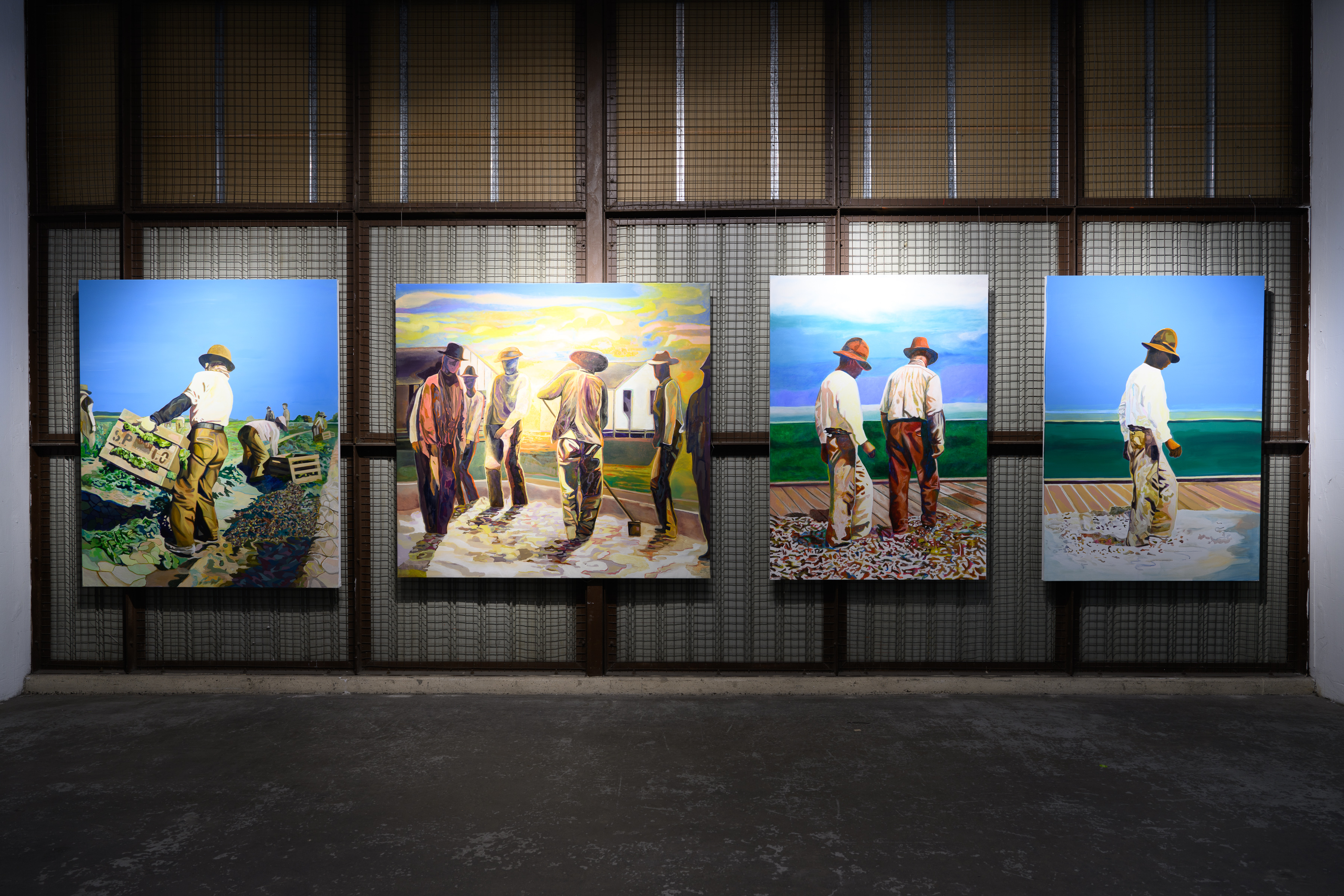
Manongs of Pajaro Valley and Louisiana Series
2025
Isang Dipang Langit, Installation View
Asian-Americans have long been regarded as “invisible Americans” due to their marginalization within the national dialogue of the United States. In response to the ongoing crisis and fear surrounding anti-Asian hate crimes, Dominic Mangila feels a strong urgency to create representations of his community by painting portraits of Asian-Americans from the past.
His artistic process involves constructing Asian-American history paintings through research and the collection of historical records, combining the genres of history painting, figurative painting, and landscape painting. The subjects of his paintings center on two narratives of the Asian-American experience: labor, migration, and trauma.
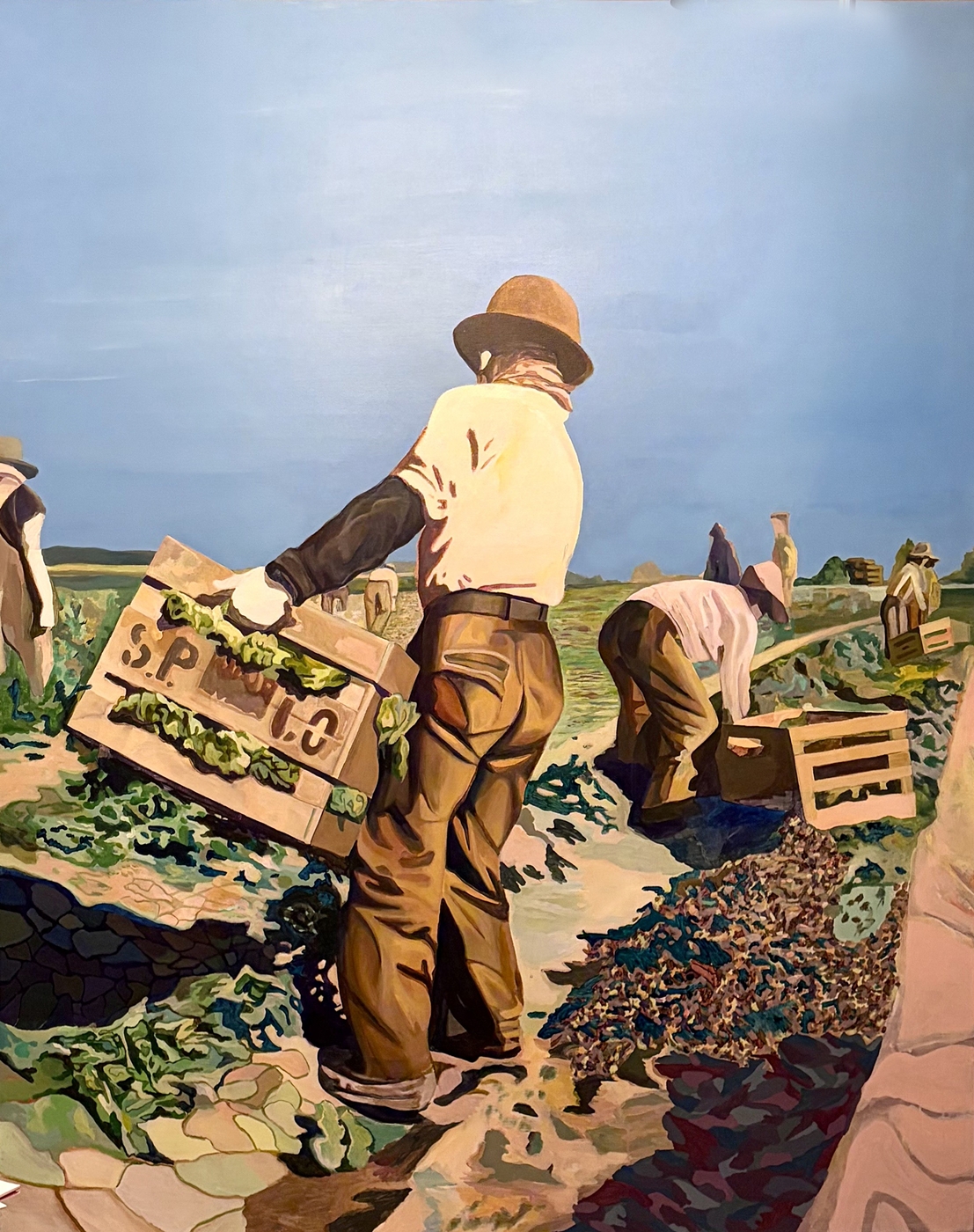
Manongs of Pajaro Valley and Louisiana Series
2025
Acryilic on Canvas
198 x 167.5 cm
Manong Generation
The “Manong Generation” refers to the first major wave of young, mostly single Filipino men who immigrated to the United States-primarily to Hawaii, California, and Alaska-in the 1920s and 1930s. “Manong,” an Ilocano term for “older brother,” was used affectionately to describe these laborers who formed the backbone of agricultural, salmon canning, and hospitality industries. They worked in fields from Washington to Arizona under harsh, low-wage conditions, facing significant racial discrimination, segregation, and anti-miscegenation laws that prevented marriage outside their race.
Most of the manongs were young, single men who left the Philippines in search of work. In Santa Cruz County, many were recruited into low-wage farm labor in the Pajaro Valley, where they picked strawberries, cucumbers, and tomatoes and sorted beans. They often worked eleven-hour days hauling irrigation pipes through muddy fields. Despite being paid less than both white and Mexican workers at the time, many still managed to send part of their wages back to family members across the Pacific.
To depict the “Manong Generation” for the exhibition at The Columns, Dominic Mangila drew from a historical photograph by Dorothea Lange, Filipino Crew of Fifty-Five Boys Cutting and Loading Lettuce, taken in Imperial Valley, California, in 1937 and held in the collection of the Library of Congress.

Manong of Louisiana 021
2025
Acryilic on Canvas
193 x 137 cm
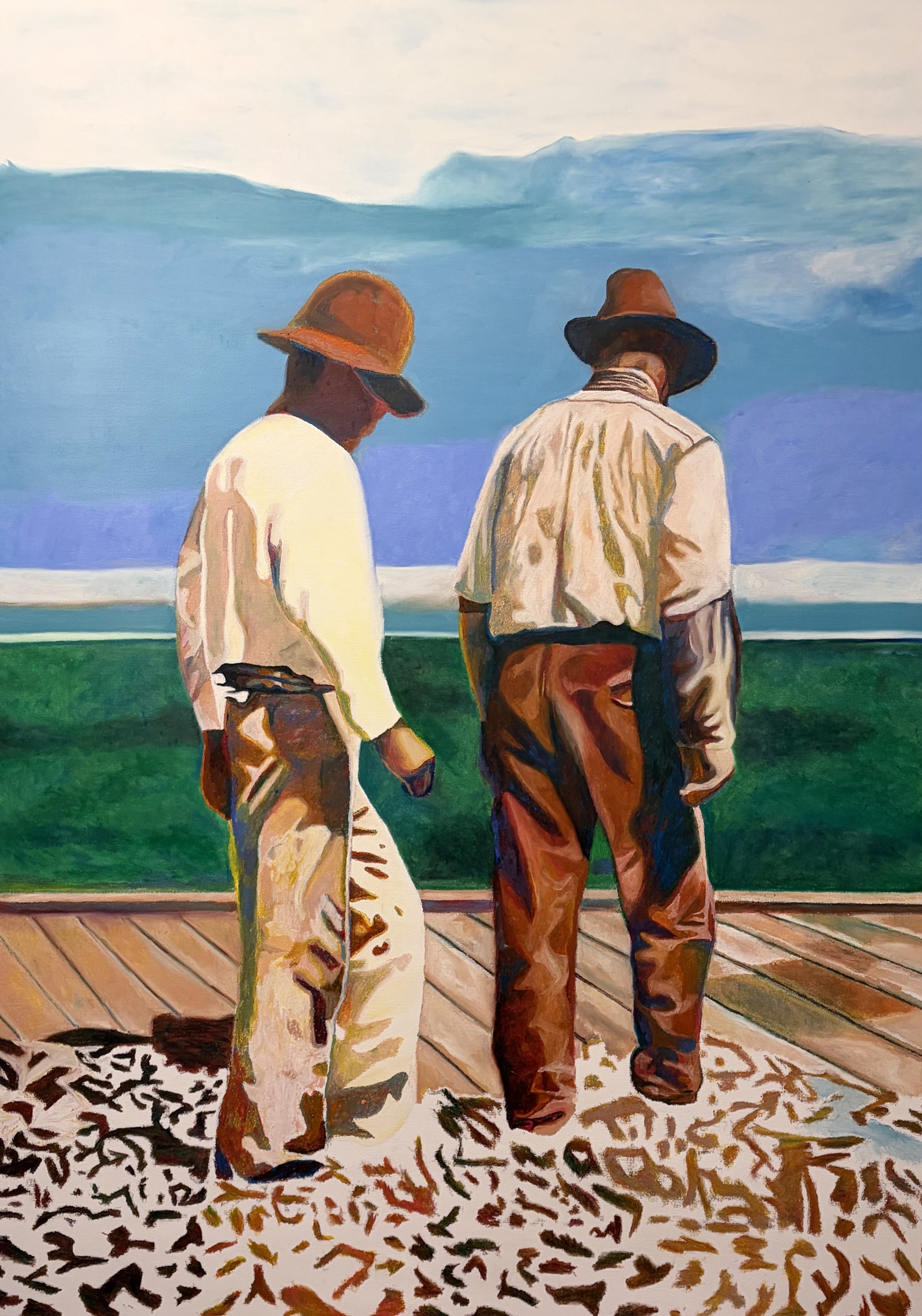
Manongs of Louisiana 020
2025
Oil and oil pastel on canvas
193 x 137 cm

Manongs of Pajaro Valley 010
2025
Acryilic on Canvas
188 x 201 cm
Shrimp Farmers of Louisiana
Dominic Mangila uses archival photographs from the State Library of Louisiana, as references for his paintings depicting Filipino shrimp farmers in Louisiana during the 1950s.
One such image documents shrimp “dancers” from a Filipino settlement in southern Louisiana at work in the 1950s. Fresh shrimp were placed on raised platforms to dry in the sun, and workers walked over the drying shrimp so that the shells would crumble and separate from the meat. The resulting dried shrimp were then collected, packaged, and sold.
Early Filipino settlers along the Louisiana coast introduced a traditional method of preserving shrimp known as the “Shrimp Dance.” In Lake Borgne, near St. Bernard Parish, these settlers-among the earliest Asian communities in the United States-established a marshland settlement called St. Malo as early as 1763. Known as the Manilamen, they adapted to the hot, humid coastal environment while maintaining cultural practices from their homeland.
Their shrimp-drying technique helped transform the regional fishing industry. Shrimp were first boiled in brine and then spread across long raised platforms to dry in the sun. After several days, workers walked in circles over the shrimp with fabric-covered feet to break the shells and separate them from the meat, producing dried shrimp that could be stored and sold.